Radar charts are a very popular visualisation tool. Recently, Anthropic released one which went viral and was used to visualise AI capability vs observed usage across occupational categories. It was widely circulated, drew significant attention, and was a main topic of discussion in technology and economics circles recently. This chart looked very authoritative, but it also obscured many dimensions as much as it revealed them.
This is not a criticism of Anthropic’s analysis but rather an observation about the type of visualisation used. The chart is widely used across many presentations, reports, research publications, and even computer games. But its broad adoption is often driven by its supposed visual appeal rather than its ability to convey information clearly.
This article makes a simple argument: radar charts are not well-suited to the comparisons for which they are most often used. And those problems are not aesthetic or visual. They come from the structural flaws of the radar charts. We will describe four of them using a simulated dataset. The dataset has been constructed to highlight the disadvantages of radar charts, not to prove a point, but to show that such applications can occur in the real world. We will describe each of those limitations, show what’s going wrong, and explain how we can present it using a more appropriate chart.
The goal is not to argue that radar charts should never be used. It is to make the disadvantages clear, so the decision to use one reflects a genuine understanding of them rather than familiarity with the format.
Problem 1: The Axis-Order Illusion
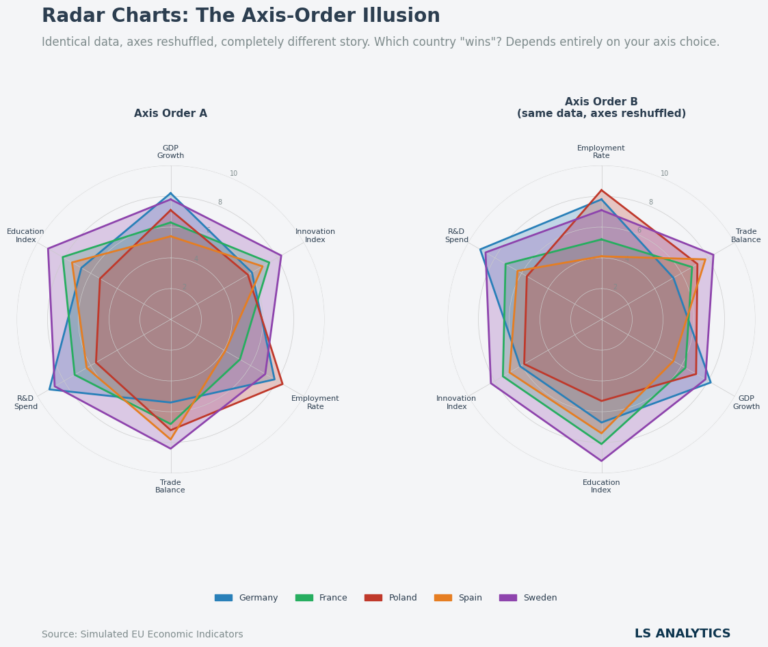
Let’s start with a simple question. In what order should the axes on the radar chart be displayed?
And we can immediately see that there are no good answers here. Unlike a bar chart, whose values can be ranked, a radar chart imposes no natural discipline on axis placement. Six metrics can be arranged in 720 different ways around the circle. The person creates a chart and decides the order of the axes, which adds another layer of subjectivity to the presentation of the data.
And such a choice is not neutral. When the axis order changes, every polygon on the radar chart changes shape with it. In our example, a country that looks strong under one arrangement can look weaker under another. The entity that usually dominates the chart, the one with the largest polygon, is partly a product of where its strongest metric happens to fall relative to adjacent axes, not purely a reflection of underlying data.
This is worth highlighting. It means that two analysts working with exactly the same dataset and using the same visualisation style can produce radar charts that tell different stories. And neither of them will be making any errors. They can simply make different axis ordering decisions, both of which will be arbitrary.
The Anthropic capability-versus-usage chart carries the same vulnerability. The occupational categories are arranged in a specific sequence around the radar. If we reorder them, the sectors that appear most underserved will shift position. The visual argument about where AI adoption is lagging is partly due to an axis placement decision for which the chart provides no basis.
And we can see it in our example above. The two charts use identical simulated data for five European countries across six economic indicators. Nothing has been changed except the sequence of axes.
But the chart shapes are different. On the first chart, Sweden looks very strong, and Germany is weaker. On the other hand, Germany’s position, in my opinion, looks stronger. And the charts should leave as few options as possible for different interpretations.
Problem 2: Area Distortion
While the axis-order problem is the most immediately apparent flaw in radar charts, area distortion is the most mathematically significant. This issue is pervasive and affects every radar chart produced.
The underlying mechanism is straightforward. In radar charts, the importance of each item is visually represented by the polygon’s size. A larger area suggests stronger performance, while a smaller area implies weaker performance. However, the area of a radar chart does not scale linearly with the underlying values; instead, it scales with the square of those values.
This means that if one country scores twice as high as another on every metric, its polygon will not appear twice as large. It will appear four times as large.
A country scoring three times as high will produce a polygon with nine times the area. The visual gap between strong and weak performers is not only exaggerated but also becomes increasingly pronounced as the difference grows. This effect is evident in the chart below, where an entity scoring twice as high as another appears disproportionately superior.
The chart below quantifies such a comparison. A score of 9 is only three times as high as a score of 3. But its radar polygon is nine times larger. The gap between the actual data representation and the visual relationship the chart presents is something very difficult to mentally correct for. And the goal of visualisations should be to present information as simply as possible. Here, radar charts are not serving this goal.
Problem 3: Cognitive Overload
The first two problems we described were quite specific to radar charts. The next one can occur with other visualisation types as well, but radar charts magnify it significantly, making radar charts difficult to consume.
To be clear, radar charts are not inherently unreadable. When composed with three or four categories, they are completely manageable. And it could be one of the reasons why they are popular.
The problem begins when we add more categories to the chart. When we do it, the axes crowd together. With more categories, polygons start to overlap. It will get very common for one polygon to overlap the ones below it. And the problems are from both the number of variables and entities. The more we add, the more unreadable radar charts get. The visual space in this format gets used up quickly.
And we can see it on the chart below. On the left side, we show 5 categories and 3 countries. The charts look manageable to read. To the right, the chart is way more complicated. Given the many countries and categories, reading the chart is difficult and requires significant cognitive effort.
Problem 4: The Occlusion Trap
The last problem we will describe arises when radar charts are used to make head-to-head comparisons of similar objects.
When the object being compared scores differently across most metrics, the radar chart can be relatively visible and easy to read, and the shapes of each polygon are distinguishable. The problems arise when all visualised entities are relatively close together, such as five similar countries or five products that score almost the same on all metrics. In such scenarios, radar charts are failing us. Comparing similar objects in a radar chart is almost impossible.
We could try fixing it by adjusting the chart opacity using the alpha parameter, but it won’t save the radar chart in that setting. We can see it on the chart below.
On the left, we can see the chart’s high opacity values. We can see the shapes of the polygons clearly, but only a few of them are visible. The middle ones aren’t visible enough – they’re almost invisible on the chart. On the right side, we lowered the opacity of charts to better preserve the comparison between countries. However, the area of each polygon is less visible now, and comparisons between them are still difficult. Either way, radar charts are basically useless for seeing subtle differences between similar objects.
The Fix
The four problems described above are structural and difficult to fix with radar charts alone. But they are also not inevitable. Choosing a different chart type can eliminate most, if not all, of them. The data and conclusions don’t change. Only the visual representation will.
Below, we will present two alternatives using the same dataset. No data was modified, and we will use the same metrics to visualise it differently.
The grouped bar chart above is not a compromise. It is an improvement in every dimension where the radar chart failed. Axis order is irrelevant as each metric occupies its own clearly labelled row, and rearranging those rows changes nothing about the comparisons within them.
Area distortion does not exist. Bar length is a linear encoding of value, the most perceptually accurate visual channel available. Complexity scales, with adding more metrics adds more rows, adding more countries adds more bars per group, and the chart remains readable throughout. Bar charts have limits here. This one is already quite heavy with data. And although it’s an improvement over the radar chart, adding more countries and metrics would make this chart harder to read.
Close comparisons are handled cleanly. When Germany and Sweden score similarly on R&D Spend, their bars sit adjacent to each other at nearly the same length, and the small difference between them is immediately visible rather than buried in overlapping polygon fill.
The heatmap offers a different trade-off. It sacrifices the precise readability of bar lengths in favour of a higher-density overview. Colour encodes the score, allowing a reader to scan the entire matrix and identify patterns across countries and metrics simultaneously. It is basically a table, but with colour encoding to make high and low values stand out more clearly. The diverging colour scale from red through the background grey to green maps naturally onto the underlying concept of low versus high performance.
Crucially, the heatmap also scales. If we added four more countries, four more rows would appear. Add three more metrics, and three more columns appear. The chart degrades gently and predictably, unlike the radar format, which becomes unusable well before it becomes complex.
Summary
Radar charts persist because they signal something. The symmetrical shape, the radiating axes, the overlapping polygons. They communicate that multiple dimensions were considered, that the analysis was thorough. This is a powerful impression to create, and it is largely why the format appears so consistently.
But as we have seen above, a radar chart does not show more than a bar chart or a heatmap. It shows the same information, encoded in a harder-to-read format, distorted by geometry, and sensitive to too many arbitrary design decisions.
These are not reasons to categorically avoid radar charts. There are reasons to deliberately reach for one. With a clear account of why the format better serves the specific data than the alternatives, rather than because it looks like the kind of chart that takes things seriously.
Most of the time, however, a bar chart is a better option. It just looks less impressive when you do it.