The most important question in almost any organisation is also the most difficult one: Did something work?
You launch a new feature, a pricing change, or a new loyalty program. And your stakeholders want to know if the specified action was successful.
The pressure to provide a fast answer is always immense. And the fastest way to evaluate the effect of a given action is to check whether a given metric has changed after it was implemented. To prove or disregard the value of such actions, analysts often reach for the simplest tool in their arsenal: Pre/Post Analysis. You just calculate the average performance before the action, do the same after it, and calculate the uplift.
It is intuitive. It is fast. And very often it is wrong.
Pre/Post Analysis relies on a single, simple, but very strong assumption. The world would have continued the same if we hadn’t performed a specific action. It assumes that, without intervention, our metrics might have remained unchanged. Hence, any change after the intervention is caused by it.
But the world is much more complex, and such a statement requires very strong certainty. After all, we have seasonality, competitors’ activity, and an almost immeasurable number of possible factors that can influence the environment.
As analysts, our job is to separate correlation from causation. In this article, we set aside intuition and use simulated data to explore how this trap works.
Scenario
Let’s start by building our simulation. To understand the Pre/Post trap, we have to first build a world where we know the truth. This way, we can easily see how it can be violated.
Imagine you are the Data Scientist at the growing e-commerce platform. The Product Team believes that the users aren’t spending enough, so they designed a new loyalty program for the most valuable customers. We will call the program ‘intervention’ to be aligned with the causal inference terminology. The program launched on 1st October 2023 and aimed to increase average revenue per user.
In our simulation, we will assume the Almighty’s power and define the ground truth. We will set the program’s true impact to exactly zero. I didn’t help us improve our revenue at all.
And we will also include the confounder, a hidden seasonal trend. As the end of the year and Holiday season approach, users start to spend more, regardless of the loyalty program.
Let’s simulate the data using the following code.
start_date = '2023-07-01'
end_date = '2023-12-31'
dates = pd.date_range(start=start_date, end=end_date, freq='D')
n_days = len(dates)
launch_date = pd.to_datetime('2023-10-01')

base_arpu = 15.0
noise = np.random.normal(0, 1.5, n_days)

day_of_year = dates.dayofyear
seasonal_trend = np.where(day_of_year > 245, (day_of_year - 245) * 0.08, 0)

true_intervention_effect = 0

daily_arpu = base_arpu + seasonal_trend + true_intervention_effect + noise
df = pd.DataFrame({'Date': dates, 'ARPU': daily_arpu})
Pre/Post Trap
As the year ended, the Product Team approached us again and asked us to measure the loyalty program’s impact. The first and correct approach is to check the daily revenue generated by our shop’s users. We plot this and see the following.
Looking at the chart above, we clearly see the results any product manager would love. The average daily revenue from our shop users was 15 USD before the launch of the loyalty program. After the program started, it increased to 21 USD per day. It’s the massive 38% uplift. The math here is perfectly accurate.
If we put this slide in the deck summarising the quarter’s performance for an audience that isn’t composed of data specialists, we could get a lot of applause for showing strong traction. And the executives would likely approve the budget to keep the loyalty program.
But we have to take a step back. As data scientists, we know that understanding the process of generating the data and driving the insights is the most important part of the job. And the chart above it is a textbook example of the Pre/Post trap. We distilled the customer behaviour into two averages, hiding the context that matters most.
Confounders
To understand why the analysis above is incorrect, we need to consider counterfactuals. It is a term from causal inference that effectively asks what would have happened otherwise.
We have to ask ourselves: What would have happened to our revenue if we had never launched the loyalty program?
And of course, this is a very difficult question. As we can never be sure about something that did not happen. There are multiple methods in causal inference trying to discover this. They even give Nobel Prizes for advances in this field.
Going back to our example. By conducting the Pre/Post analysis, we assumed that our counterfactual is the same as before. To be specific, we assume that without the loyalty program, the average revenue per user would remain the same as before, around 15 USD. Hence, any uplift after the launch is attributed to the loyalty program.
It is not difficult to see how strong this assumption is. In all cases when running it, we assume that the results observed in the past would be exactly the same in the future in the absence of measured action.
And we also know it is not true in our example. In the simulation, we introduced a seasonal trend. There is a natural increase in spending during the holiday shopping season in the last quarter of the year.
And it’s exactly shown in the chart above. The seasonal trend shows that the revenue started to increase just before the launch of the loyalty program. It started rising in September, and the loyalty program launch did not affect it.
Going further, we can see that the ‘post’ period coincided with the holiday season. The users were going to spend more money anyway. In reality, the new loyalty program did not contribute to the increase in customer revenue at all. The entire lift observed before is only us taking the credit for the holiday season.
This is why Pre/Post Analysis is dangerous. It blinds us to external factors (confounders) like seasonality, competitors’ activity, and economic trends. All those factors can simultaneously influence our metrics of interest, making a simple comparison unreliable.
So, if we can’t trust the ‘Before vs. After’ comparison, what are the alternatives?
Solutions
We need a method that captures the counterfactual. The approach that helps us to answer what would have happened without the loyalty program. The best approach is to conduct a Randomised Controlled Trial (RCT) or an A/B Test, using whichever term is more business-oriented.
The basic logic to run is quite simple. And I’m simplifying here on purpose, as the design of the experiment can get way more complicated to avoid negative effects, like spillover. But let’s keep things simple to understand the logic.
Instead of launching the loyalty program to everyone, we split our users into two groups selected at random. The treatment group will get access to the new program, and the control group won’t. And we assume that the customers in the control groups won’t have any knowledge about the program.
Because both groups exist simultaneously, they are both exposed to the same external factors. And what’s more, due to random selection, they are comparable in all observable and unobservable characteristics. The only thing that makes them different is receiving a loyalty program. For example, both groups will spend more during the holiday season, leading to higher spending.
By comparing the two groups, we automatically control for all confounders. And any difference in revenue between them will be solely due to the treatment.
Let’s simulate the results of such an A/B test on the chart below.
Running an experiment confirms what we observed in the section before. Here, the lines for the control and treatment groups move in exactly the same direction after the launch of the loyalty program.
It shows that the program’s incremental impact is effectively zero. The A/B isolation separated the treatment from external noise. Running the test helps the company save money by avoiding the cost of investing millions in a program that doesn’t actually work.
Can Pre/Post analysis ever be useful
After seeing those results, we might be tempted to ban the Pre/Post analysis entirely. But before we do it, let’s assess whether it can ever be useful and under what conditions. After all, there are many situations in which running an A/B test is impossible.
If we are forced to use Pre/Post analysis, we must acknowledge the strong assumptions underlying it. There is no escape from it.
This analysis requires that the statistical properties of our metric of interest are constant in the world without the treatment. We assume that everything would have remained the same over time without intervention. We are basically betting that nothing else in the world has changed.
And we can already see how hard it is to achieve it. One has to have a thorough understanding of a given problem to claim it.
And if we really don’t have a choice and have to make such a comparison, it’s always better to track changes over a shorter time frame. For example, comparing data at the daily or hourly level is much safer than at the monthly level. Simply, fewer factors can change in a shorter time frame.
And the higher the probability, the more likely the event caused it. We can be much more certain that a 60% drop in website traffic was caused by the technical error than a 2% decrease. This is, of course, a rule of thumb, not a scientific or fixed approach.
And it’s always better to have some benchmarks to compare changes. For example, when we see the result of the change in the registration form in one region, it’s always good to compare the trends with those in other regions. Basically, anything that can reduce our uncertainty is useful. And in all cases when we are forced to run Pre/Post Analysis, we must always consider domain knowledge, experience, and sometimes a bit of common sense.
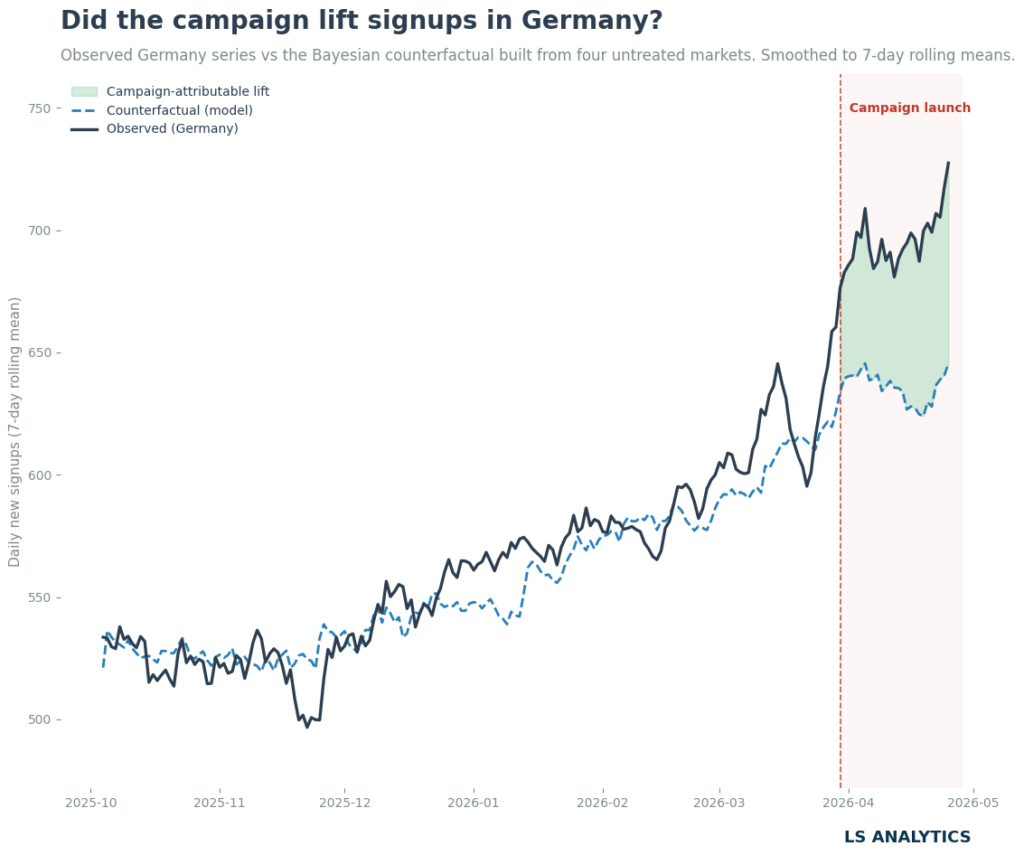
And not everything is lost, even if we can’t run an A/B Test easily. There is a large and very useful family of quasi-experimental methods, such as difference-in-differences with a synthetic control group. They are designed to help us discover the causal effect even from the observational data. It is a core of causal inference, and it’s always preferable to use such tools instead of relying solely on Pre/Post Analysis. Especially when the potential cost or benefit of discovering the true causal effect is large.
Summary
If there is one lesson our example shows us, it is that timing is not causation. Just because two things happen at the same time, like the loyalty program and a spike in revenue, doesn’t mean that one caused the other. As we saw, a 38% lift can in reality be non-existent.
Analysts are often rushed to deliver results and showcase the effect of something. But it’s not what we are paid for. We are paid to deliver or be as close to the truth as possible. That’s why understanding the pitfalls of the Pre/Post Analysis is essential. And it also shows why causal inference is so important. It helps us discover the truth in a messy, complicated world.