When BlueCo, the consortium behind Chelsea FC, acquired RC Strasbourg in 2023, it signalled a major shift in the multi-club ownership landscape. The vision was clear: build a network similar to the Red Bull or City Group models, creating an ecosystem for shared scouting, data, and player development.
The BlueCo Strasbourg deal promised financial stability and, crucially, access to a superior talent pool. Within months, the link became tangible as Chelsea prospects like Andrey Santos and Angelo Gabriel arrived on loan, turning the Alsatian club into a high-level testing ground.
But has this “ecosystem” actually translated into success on the pitch? To answer this, we combine traditional metrics with synthetic control-group modelling to estimate the acquisition’s causal effect.
The surface level: a season of record results
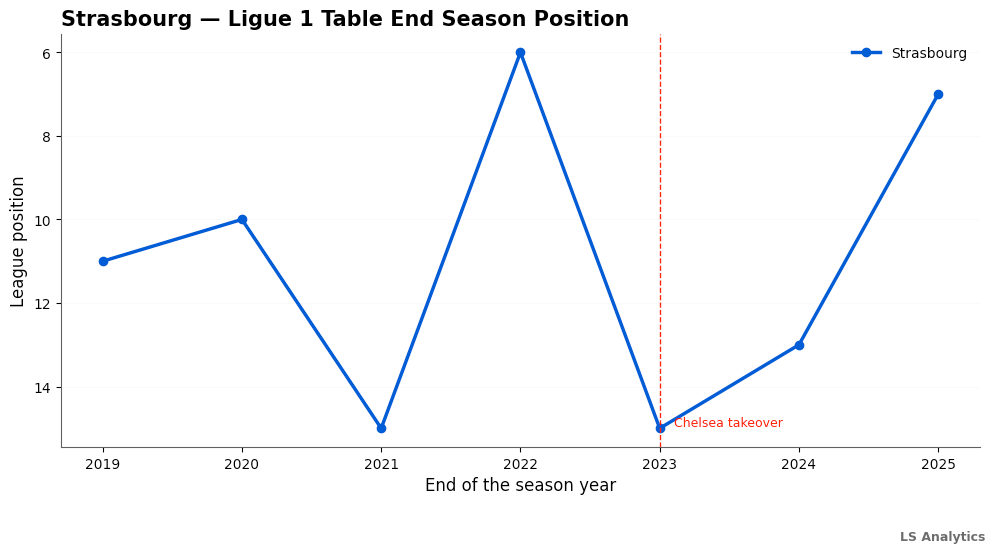
The main way to assess a football club’s performance is its league position; after all, it’s the ultimate sign of the team’s strength.
Strasbourg’s position shows us evolution, but definitely not a revolution. The club’s performance in the season immediately after the acquisition showed no quick improvement. The real change came in the 2024/2025 season.
This season, Strasbourg finished 7th, one of the team’s best results in recent years. This position helped the team qualify for the European Conference League and return to the continental stage.
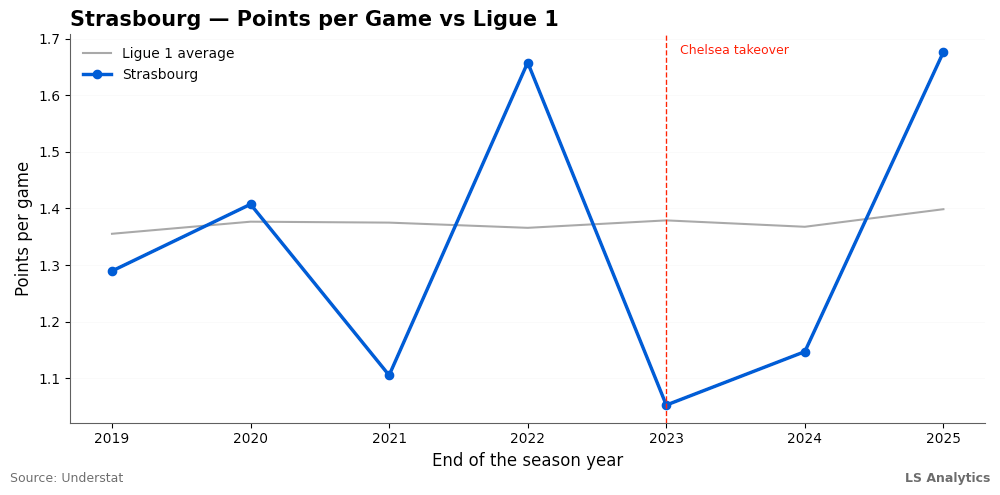
By points scored per game, Strasbourg’s post-acquisition trajectory looks very promising. The 2022/2023 season saw a drop in performance, but the following campaign was Strasbourg’s best since 2019.
The improvement aligns with the influx of new players or, perhaps more importantly, with a new coach.
In 2024, the club announced that it had appointed a new manager from England, Liam Rosenior. A more disciplined tactical approach led to Strasbourg’s best season in years.
The club moved from near the relegation zone to a stable position in the elite of French football.
The efficiency paradox: overperforming the xG model
But how efficient was Strasbourg’s performance in the 2024/2025 season? Was it due to an increase in skills or tactics, or was it more about sheer luck?
Let’s have a look at a less obvious football efficiency evaluation.
Digging into the data, we can see how Strasbourg performs on expected goals, a metric used to evaluate the quality of situations a team creates.
In football analytics, expected goals (xG) and expected goals against (xGA) have become essential tools for assessing a team’s performance. These metrics are not perfect and leave ample room for interpretation, but they can help evaluate a team’s performance more rigorously.
Expected goals evaluate the quality of each shot by estimating the probability it will result in a goal.
It is based on extensive historical data from a similar situation, along with factors such as shot location, angle, and distance to the goal. A high xG means a team creates good scoring opportunities, even if they don’t convert.
Expected goals against follow the same logic but in the opposite direction. It measures how many goals a team is expected to concede based on the quality of shots it faces. The lower the xGA, the better, as it indicates how effective the team’s defence is.
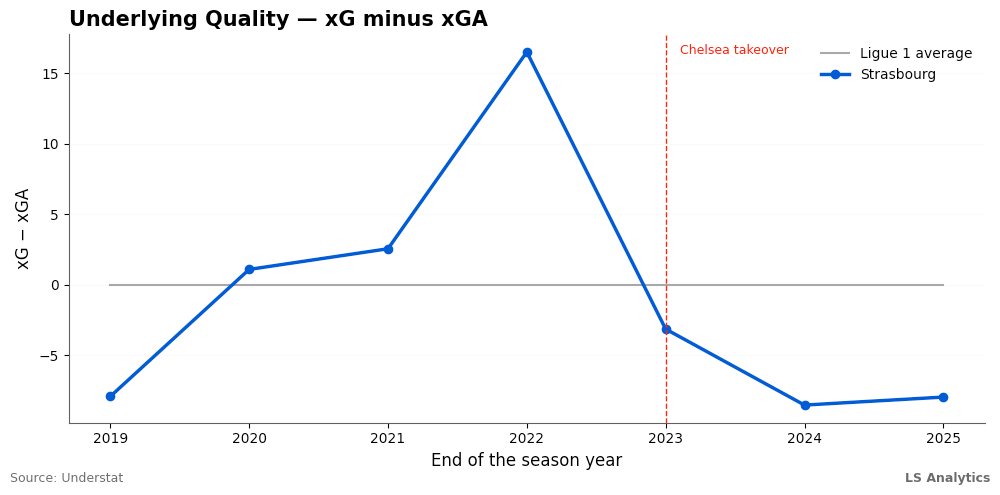
The gap between expected goals and expected goals against doesn’t look as good for Strasbourg as the points scored. The xG minus xGA balance turned negative, meaning the team was conceding higher-quality chances than it created. What’s more striking is that this difference had been steadily improving before Chelsea’s acquisition.
And this is where it gets interesting, as it shows a disconnect between Strasbourg’s strong league position and its theoretical performance. Strasbourg was the only top-8 club in Ligue 1 with a negative expected goals difference.
The talent hack: why individual quality mattered
Does it mean that Strasbourg’s results in 2024/2025 were obtained only due to luck? This statement would not be fair towards players who actually performed on the pitch. The most sensible explanation is that the individual quality of Strasbourg’s players helped overcome the lower quality of the chances.
The Strasbourg goalkeeper Djordje Petrovic (on loan from Chelsea) was among the best in Ligue 1, ranking second in the percentage of goals saved. He saved many difficult shots, even when the defence allowed them.
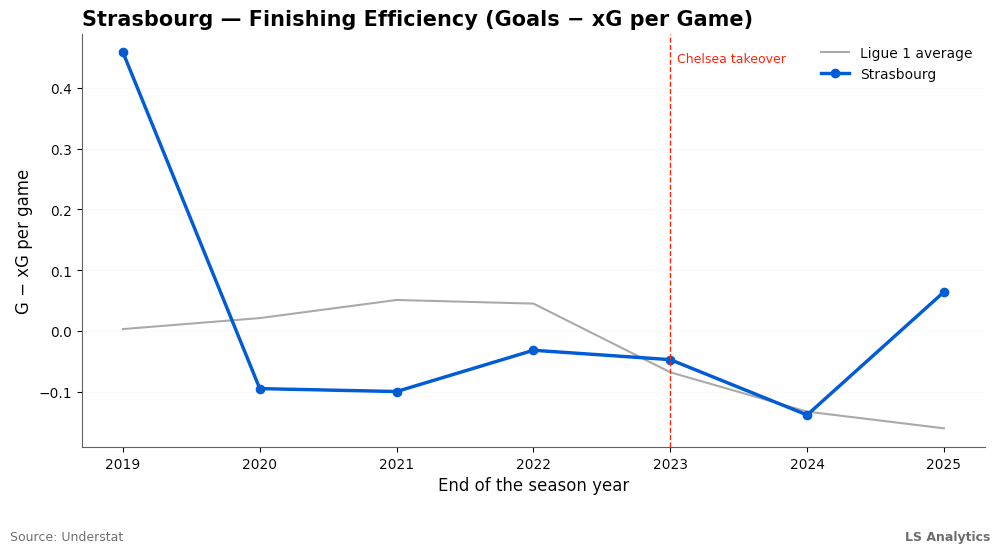
Their attack was also good at converting lower-quality chances. The difference between goals scored and expected goals increased drastically in the 2024/2025 season. They finished situations successfully when the probability of success was relatively low.
This shows the higher quality of players who could score in challenging situations. Luck could also influence football. Or most likely both of them.
We can certainly highlight Strasbourg’s top goalscorer this season, Emanuel Emegha. He scored 14 goals, with an xG of 17, meaning that he could have scored much more if he had finished better.
But the true star performer of Strasbourg was Andrey Santos.
The midfielder scored 10 goals with an xG of 6.6, according to Understat. His performance was a main reason for the Alsatian team’s offensive overachievement. And where does Andrey Santos play now? At Chelsea. He was on loan at Strasbourg.
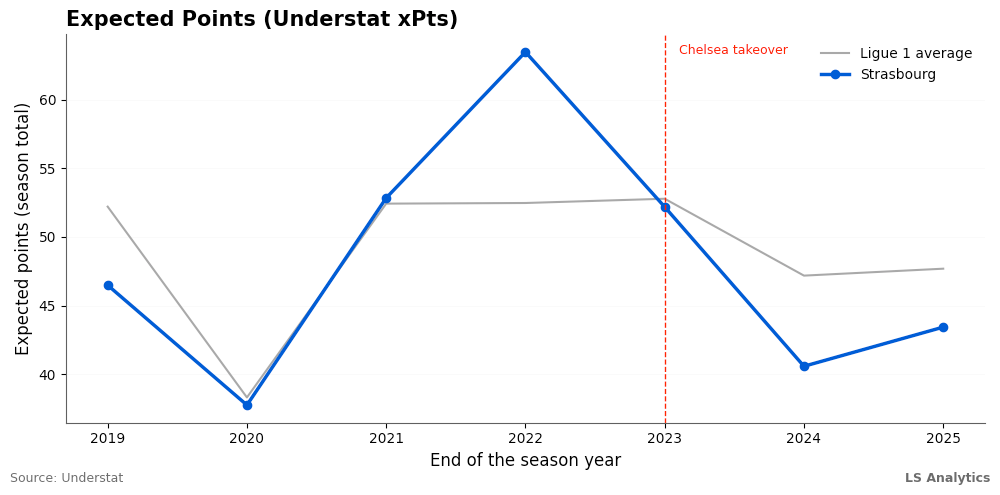
An analysis of expected goals leads to checking expected points per game. The metrics estimate how many points the team should have scored based on their balance between expected goals and expected goals against in each game.
This metric evolution differs significantly from what we observed in the team’s actual points scored. These metrics only confirm what we observed above. Since 2021, the expected points have steadily declined, and Chelsea’s acquisition has not changed that.
In other words, in the 2024/2025 season, Strasbourg overperformed relative to their chances. This suggests the team’s performance in the previous season was driven more by individual achievements and luck than by consistent improvement in team quality.
The counterfactual: measuring the BlueCo Strasbourg lift
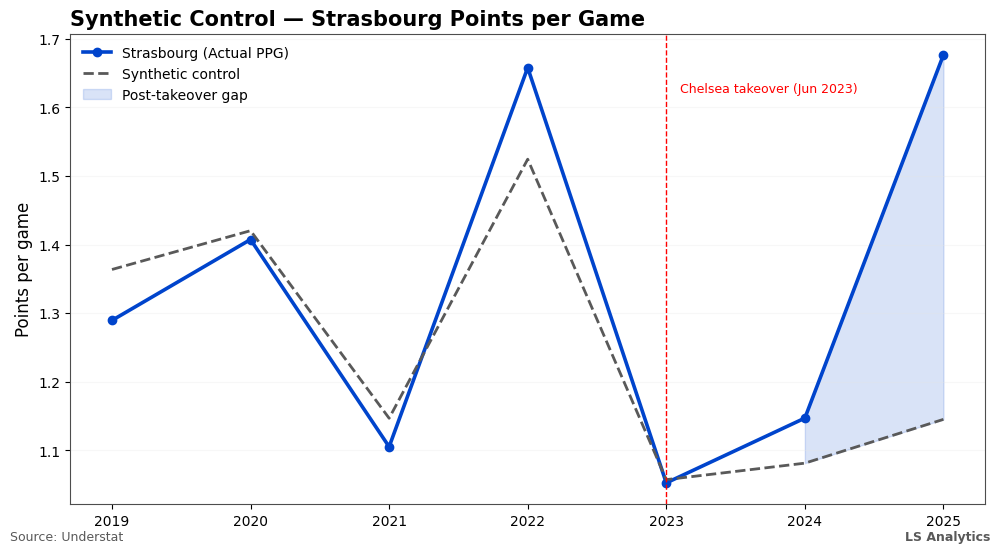
To move beyond correlation and test the points above, we built a synthetic control group model, applying a popular causal inference method to football analytics.
It’s a statistical method that estimates what would have happened to Strasbourg if BlueCo hadn’t acquired it. It does so by comparing Strasbourg’s pre-acquisition performance with that of similar teams.
The result is a counterfactual, an estimate of how Strasbourg would likely have performed had the BlueCo takeover never happened.
When we compare the two lines, the real Strasbourg versus its synthetic counterpart, the outcome is clear.
After 2023, points per game rose above synthetic Strasbourg. This suggests a genuine and positive ownership effect on short-term results.
But the high performance was most likely due to an increase in player quality. Loaned players from Chelsea brought a level of skill that improved Strasbourg’s results beyond what the team could have produced on its own.
Strasbourg’s main goal in the coming seasons must be to stabilise the team’s performance, relying not only on individual skill or luck but also on consistent performance across the squad.
Verdict: Sustainable Growth or Individual Brilliance?
The BlueCo acquisition has delivered a short-term performance uplift for Strasbourg. It was driven primarily by the arrival of high-quality players from Chelsea, who raised the team’s performance, helped Strasbourg convert lower-quality chances, and defended difficult situations.
This is the practical manifestation of multi-club ownership: access to elite talent that translates into better results.
Yet the data also suggest that Strasbourg’s underlying quality, chance creation, and defensive quality remained largely unchanged before the 2025/2026 season. The club was winning more efficiently, but the wins came from individual player quality.
Strasbourg fans must ask whether BlueCo’s takeover will deliver long-term gains.
It depends on many factors, and only time will tell, but the foundations for future success already exist. The team must now focus on further improvements to achieve more consistent performance without relying solely on individual brilliance.